Survey of Qubit Representations
February 27, 2026Because we humans are macroscopic beings who constantly interact with our environment, reasoning about the behavior of individual particles in a closed system — quantum behavior — can be difficult. Even the simplest quantum mechanical systems around, the spin-1/2 systems that people call quantum bits or qubits, aren’t much easier. Folks have designed many ways to represent qubit states. This post lists all the ones I have found.
Summary
| Name | Example 1Q State | Example 2Q State | Phase | Refs. |
|---|---|---|---|---|
| Bra–ket/Dirac notation | $\frac{1}{\sqrt{2}}\left(\vert 0\rangle - \vert 1\rangle \right)$ | $\frac{1}{\sqrt{2}}\left(\vert 00\rangle - \vert 11\rangle \right)$ | $\theta$ | [1, Fig. 2.1], [2, App. A], [3, Sec. 2.2] |
| Matrices | $\frac{1}{\sqrt{2}}\begin{bmatrix}1 \\ -1\end{bmatrix}$ | $\frac{1}{\sqrt{2}}\begin{bmatrix}1 \\ 0 \\ 0 \\ -1\end{bmatrix}$ | $\theta$ | [4, Chap. 3] |
| Coordinates | $\begin{aligned}a(0) &= \frac{1}{\sqrt{2}} \\ a(1) &= -\frac{1}{\sqrt{2}}\end{aligned}$ | $\begin{aligned}a(00) &= \frac{1}{\sqrt{2}} \\ a(11) &= -\frac{1}{\sqrt{2}}\end{aligned}$ | $\theta$ | [5, Chap. 3] |
| Bloch sphere | 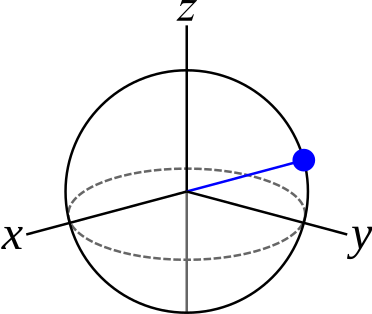
|
N/A | $\theta$ | [1, Sec. 1.2, Sec. 4.2], [3, Sec. 2.5.2], [4, Chap. 2], [5, Sec. 14.4] |
| 2D plane/unit circle | 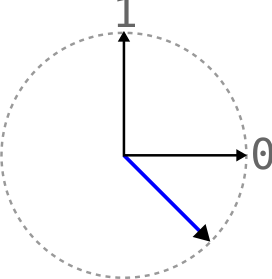
|
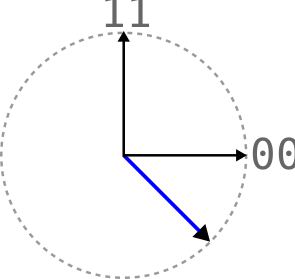
|
$\pm$ | [3, Fig. 2.4, Fig. 9.2], [1, Fig. 6.3], [2, Fig. 4.3] |
| Q is for Quantum | 
|
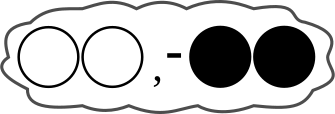
|
$\pm$ | [6], [7] |
| Qwerty | '0'-'1' |
'00'-'11' |
$\theta$ | [8] |
| Knot | N/A | 
|
❌ | [9], [10] |
| Circle notation | 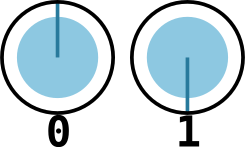
|
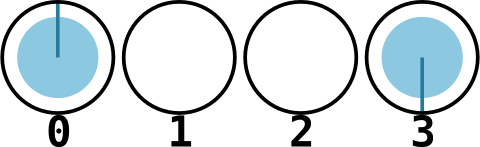
|
$\theta$ | [11] |
| Square notation | 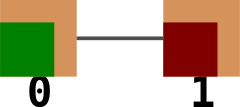
|
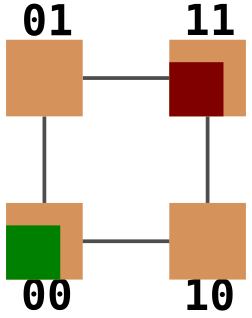
|
$\color{green}\theta$ | [12] |
| Dimensional circle notation | 
|
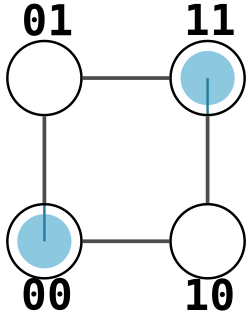
|
$\theta$ | [13] |
| Pie chart | 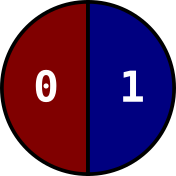
|
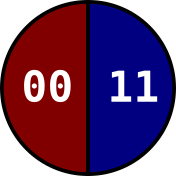
|
❌ | [14] |
| State-o-gram | 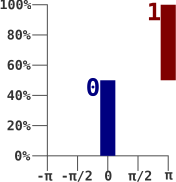
|
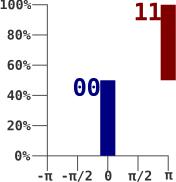
|
$\theta$ | [15] |
| Q-sphere | 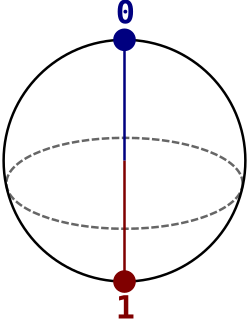
|
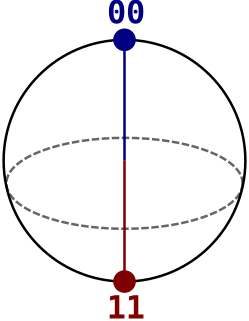
|
$\color{green}\theta$ | [16] |
| BEADS | 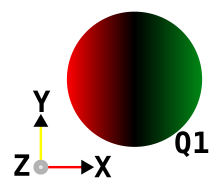
|
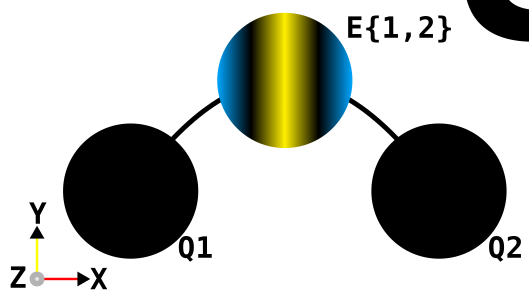
|
$\theta$ | [16] |
Phase column key:
- ❌: Phase not represented
- $\pm$: Only phases of $\pm 1$ represented
- $\color{green}\theta$: All phases $e^{i\theta}$ represented using color
- $\theta$: All phases $e^{i\theta}$ represented
Bibliography
- M. A. Nielsen and I. L. Chuang, Quantum Computation and Quantum Information: 10th Anniversary Edition. Cambridge University Press, 2010.
- N. D. Mermin, Quantum Computer Science: An Introduction. Cambridge University Press, 2007.
- E. G. Rieffel and W. H. Polak, Quantum Computing: A Gentle Introduction. Cambridge, Massachusetts London, England: The MIT Press, 2014.
- B. Burd, Quantum Computing Algorithms: Discover how a little math goes a long way. Birmingham: Packt Publishing, 2023.
- R. J. Lipton and K. W. Regan, Introduction to Quantum Algorithms via Linear Algebra, second edition. Cambridge, Massachusetts: The MIT Press, 2021.
- T. Rudolph, Q is for Quantum. Wroclaw: Terence Rudolph, 2017.
- S. E. Economou, T. Rudolph, and E. Barnes, “Teaching quantum information science to high-school and early undergraduate students,” Aug. 08, 2020, arXiv: arXiv:2005.07874.
- A. J. Adams et al., “Qwerty: A Basis-Oriented Quantum Programming Language,” in Proceedings of the 2025 IEEE International Conference on Quantum Computing and Engineering (QCE ‘25), Aug. 2025, pp. 804–815.
- P. K. Aravind, “Borromean Entanglement of the GHZ State,” in Potentiality, Entanglement and Passion-at-a-Distance: Quantum Mechanical Studies for Abner Shimony Volume Two, R. S. Cohen, M. Horne, and J. Stachel, Eds., in Boston Studies in the Philosophy of Science. Dordrecht: Springer Netherlands, 1997, pp. 53–59.
- A. Sugita, “Borromean Entanglement Revisited,” In Proceedings of International Workshop on Knot Theory for Scientic Objects, Mar. 2006, Osaka, Japan.
- E. R. Johnston, N. Harrigan, and M. Gimeno-Segovia, Programming Quantum Computers: Essential Algorithms and Code Samples. O’Reilly Media, Inc., 2019.
- B. Just, Quantum Computing Compact: Spooky Action at a Distance and Teleportation Easy to Understand. Berlin, Heidelberg: Springer, 2022.
- J. Bley et al., “Visualizing entanglement in multiqubit systems,” Phys. Rev. Res., vol. 6, no. 2, p. 023077, Apr. 2024.
- K. Yeung, Quantum Computing & Some Physics: The Quantum Computing Comics Notebook. 2020.
- F. Schinkel, “state-o-gram – A Novel 2D Visualization for Quantum States,” Aug. 25, 2025, arXiv: arXiv:2508.18390.
- IBM Quantum Composer. 2025.